Advanced information and communication technologies

Advanced information and communication technologies (ICT) bring together telecommunications, computers and software. Advanced ICT systems let us process and transfer data at greater speed and volume.

We have updated the data in this list since we first published it in 2021. Find previous datasets in the National Library of Australia’s Trove website archive.
Example technologies

  • Advanced data analytics
  • Advanced optical communications
  • Advanced radiofrequency communications, including 5G and 6G
  • High-performance computing
  • Protective cyber security technologies
  • Virtual worlds

Example applications

These technologies can be used for:

  • space communications, including communicating with earth during deep-space exploration
  • high-bandwidth, low-latency satellite communications
  • big data modelling and analysis
  • improved cyber security
  • systems to manage air traffic, public transport and crowds
  • faster and more resilient emergency management in remote areas
  • real-time augmented and virtual reality
  • automating industry and agriculture
  • connecting internet of things (IoT) devices.

Research trends

Australia’s research strengths in critical technologies underpin new economic opportunities and sovereign capabilities.

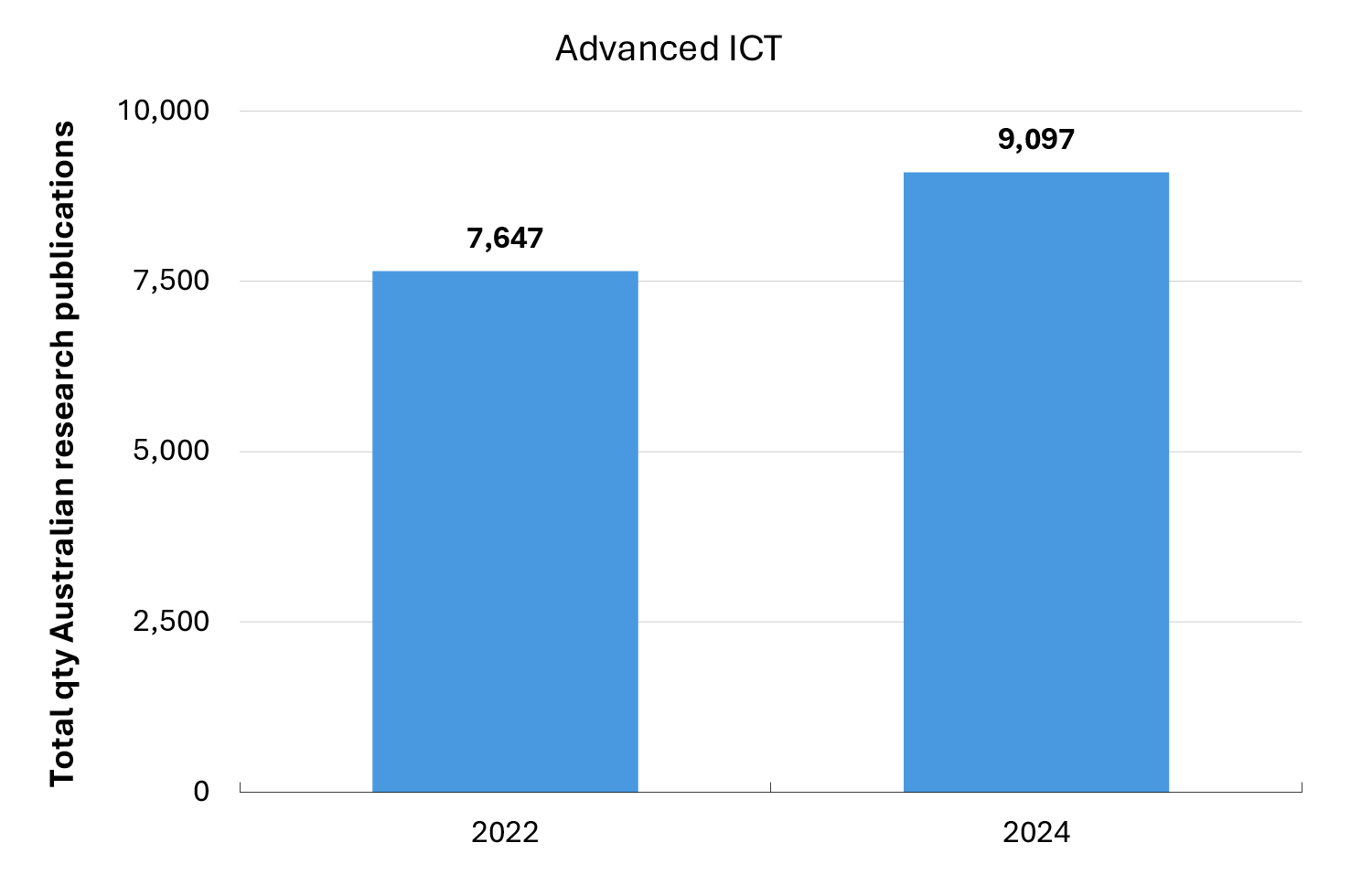
From 2022 to 2024, Australia’s research trends are consistent across critical technology fields, with advanced ICT seeing a notable increase in publications. 

Research quality and research specialisation remained the same from 2022 to 2024. We define quality as the percentage of publications in the top 10% most cited publications in the field. We define specialisation as the ratio of the share of a field in the publications that come from a given country to the share of the same field in the global total of publications.

See next tab.

Australian research publications for advanced information and communication technologies field, 2022–2024. 

Total quantity of Australian publications in advanced ICT
  2022 2024
Publications 7647 9097

Patent trends 

Intellectual property (IP) rights are vital to supporting translation of critical technology research outcomes into products, businesses and new capabilities. 

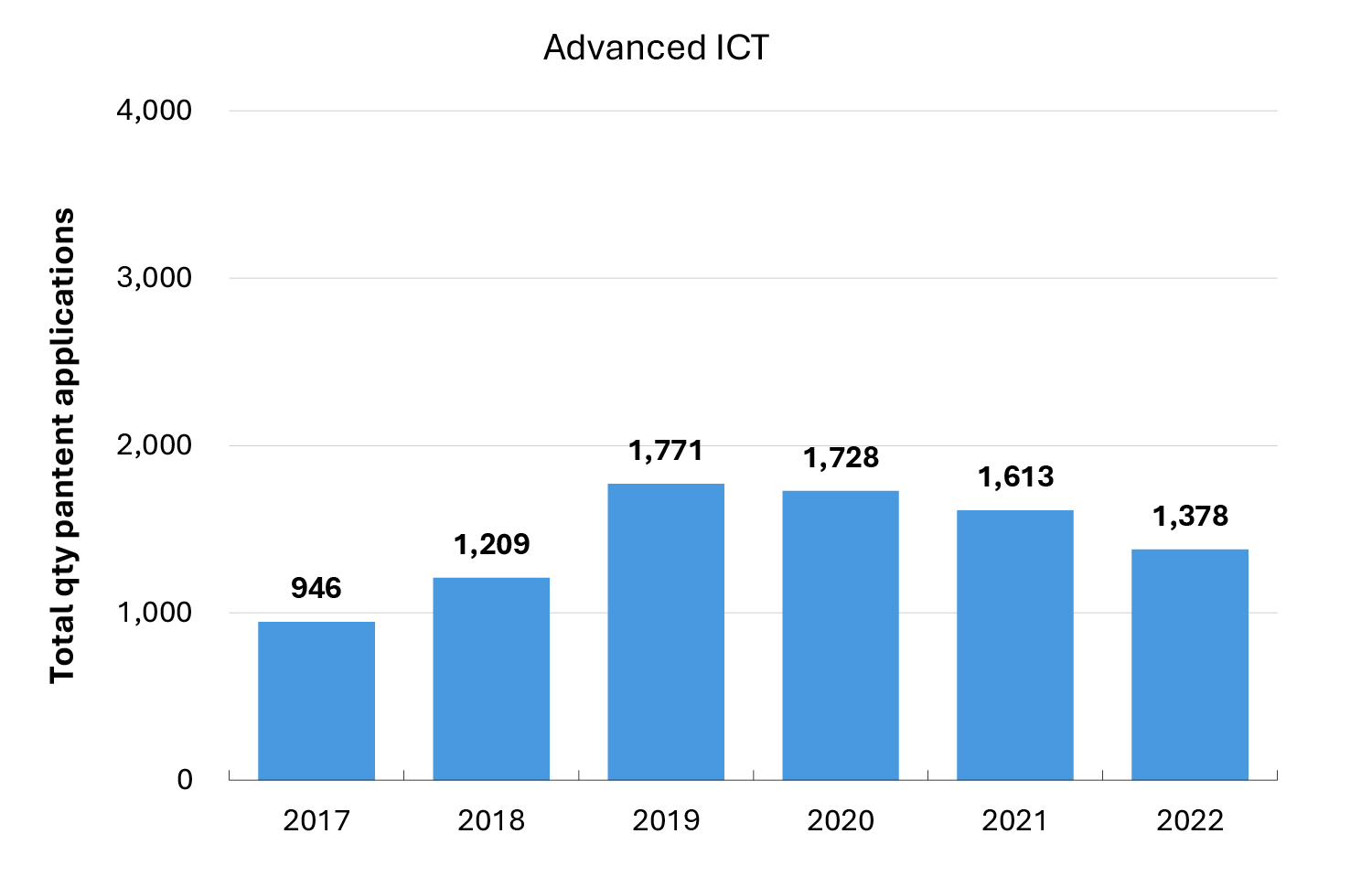
Advanced ICT (standard) patent applications nearly doubled from 2017 to 2019 with a slight drop off in 2020 which continued to 2022. 

See next tab.

Advanced information and communication technologies (standard) patent applications in Australia, 2017–2022.

Advanced ICT (standard) patent applications in Australia, 2017–2022
  2017 2018 2019 2020 2021 2022 % growth
Patent applications 946 1209 1771 1728 1613 1378 45.67

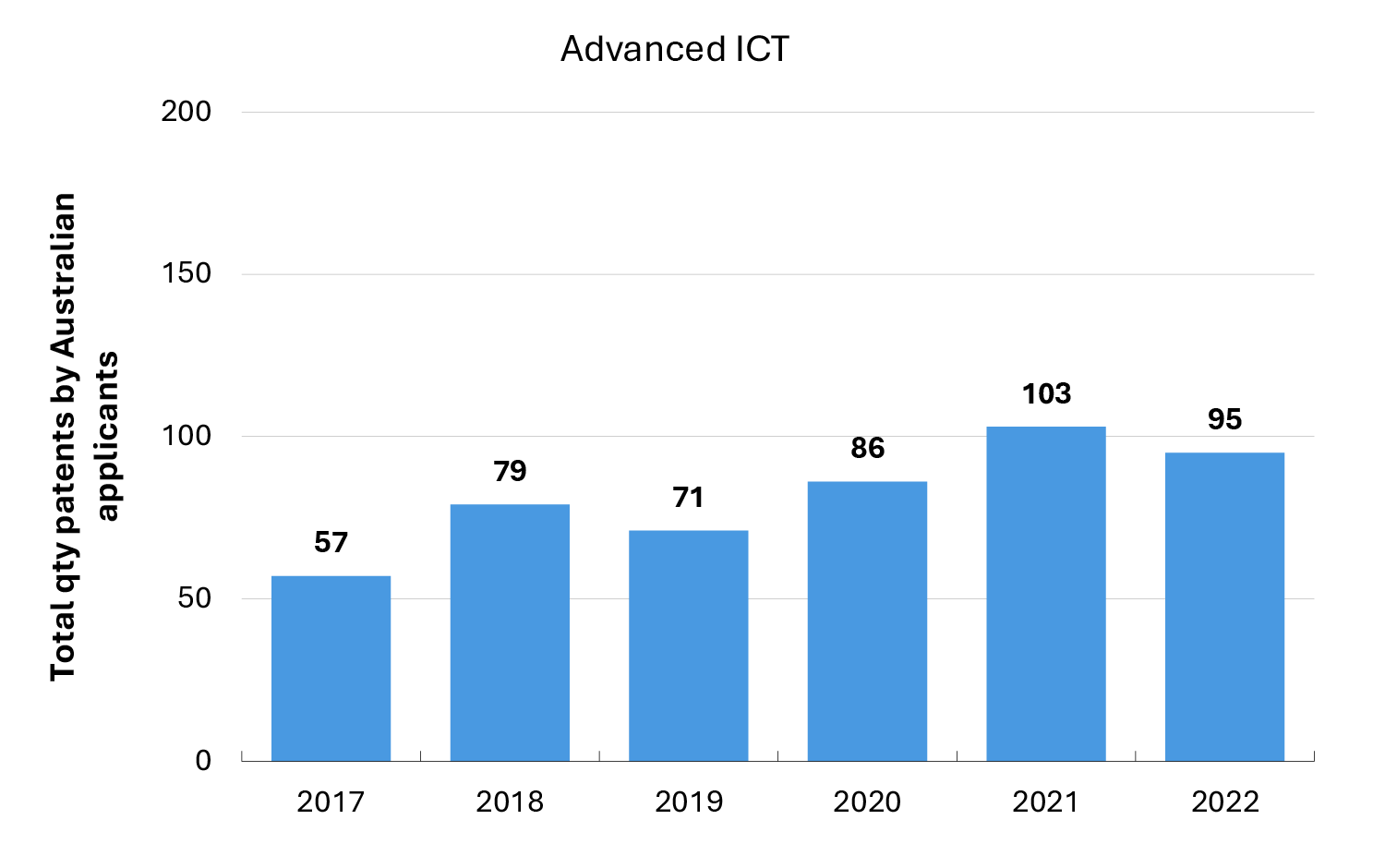
Advanced ICT (standard) patent applications by Australian applicants doubled from 2017 to 2021 with a slight decrease in 2022.

See next tab.

Advanced information and communication technologies Australian applicant (standard) patent applications in Australia, 2017–2022.

Advancing ICT Australian applicant (standard) patent applications in Australia, 2017–2022
  2017 2018 2019 2020 2021 2022
Patent applications 57 79 71 86 103 95

Venture capital trends 

Venture capital (VC) investment data can help assess Australia’s critical technology capability. The data acts as a real-time signal of where private investment is supporting innovation. 

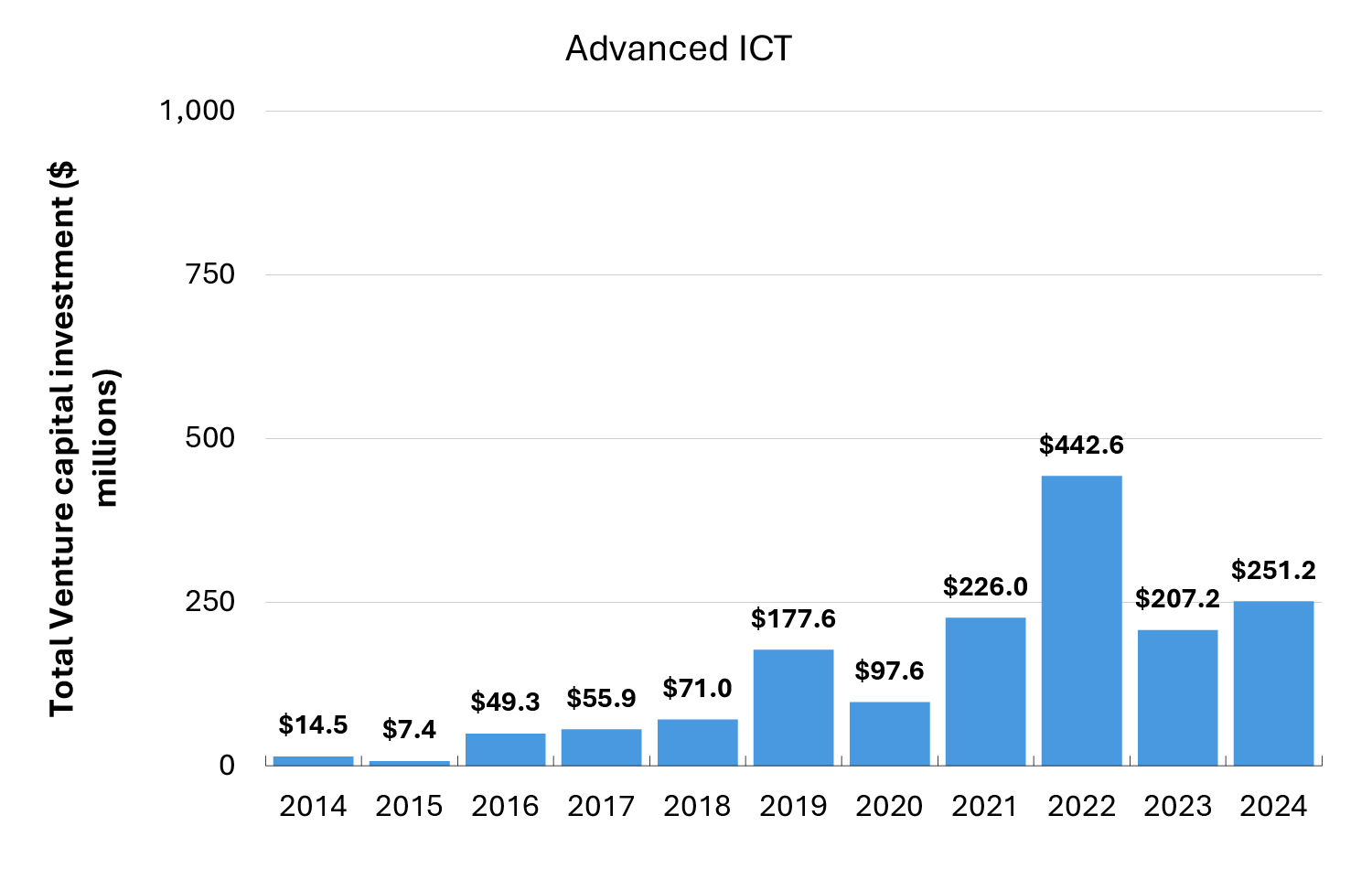
Overall VC investment in Australian advanced ICT critical technology firms increased in 2024. Global trends underpinned by inflation, economic tension and global conflicts may attribute to falls seen in 2023.

See next tab.

Venture capital investment in Australian advanced information and communication technologies firms, 2014–2024.

Venture capital investment in Australian advanced ICT firms, 2014–2024
Year VC investment in $millions
2014 14.5
2015 7.36
2016 49.34
2017 55.88
2018 71
2019 177.61
2020 97.63
2021 225.97
2022 442.63
2023 207.21
2024 251.22
Total 1600.35

The future

Australia is well-placed to take advantage of new ICT developments such as 6G.

We need these advanced technologies to:

  • develop new products and services
  • improve business efficiency
  • secure digital systems and networks
  • help us transition to a digital economy (an economy in which most activity uses ICT in some form).

Smart technologies are already being embedded in the workforce and our physical environments. With the right infrastructure and support, these technologies can make our industries more productive and our businesses more competitive.

Data sources

CSIRO collected all publication data from Web of Science systems and covers 2022 and 2024.

We sourced all patent data from IP Australia. The data covers 2017 to 2022 for standard patent applications filed in Australia. It does not include innovation patents, following a 2022 review phasing them out. We note innovation filings were on the rise during this period, which led to a spike in the years leading up to ceasing. 

DISR collected all VC data in March 2025 using Pitchbook and covers 2014 to 2024.