Advanced manufacturing and materials technologies

These technologies are used to manufacture and modify materials in ways that improve their performance. Advanced materials may be used for their structural properties or functional ones like chemical, magnetic or electrical properties.  

We have updated the data in this list since we first published it in 2021. Find previous datasets in the National Library of Australia’s Trove website archive

Example technologies

  • Additive manufacturing, including 3D printing
  • Critical minerals extraction and processing
  • Advanced composite materials
  • High-specification machining processes
  • Semiconductors and advanced integrated circuit design and manufacture

Example applications

These technologies can be used for:

  • safely storing and transporting liquids and gases, such as hydrogen
  • better composite structures
  • compact emergency distress beacons
  • detecting toxic gases
  • ultra-thin antennas
  • advanced flexible, printable and highly durable photovoltaic cells
  • personalised biomedical devices, including improved orthopaedic devices
  • specialised semiconductors and thermal and radiation-resistant materials, for use in space and other environments where reliability is important
  • stronger, lighter vehicle components, including advanced aerospace propulsion hardware.

Research trends

Australia’s research strengths in critical technologies underpin new economic opportunities and sovereign capabilities.

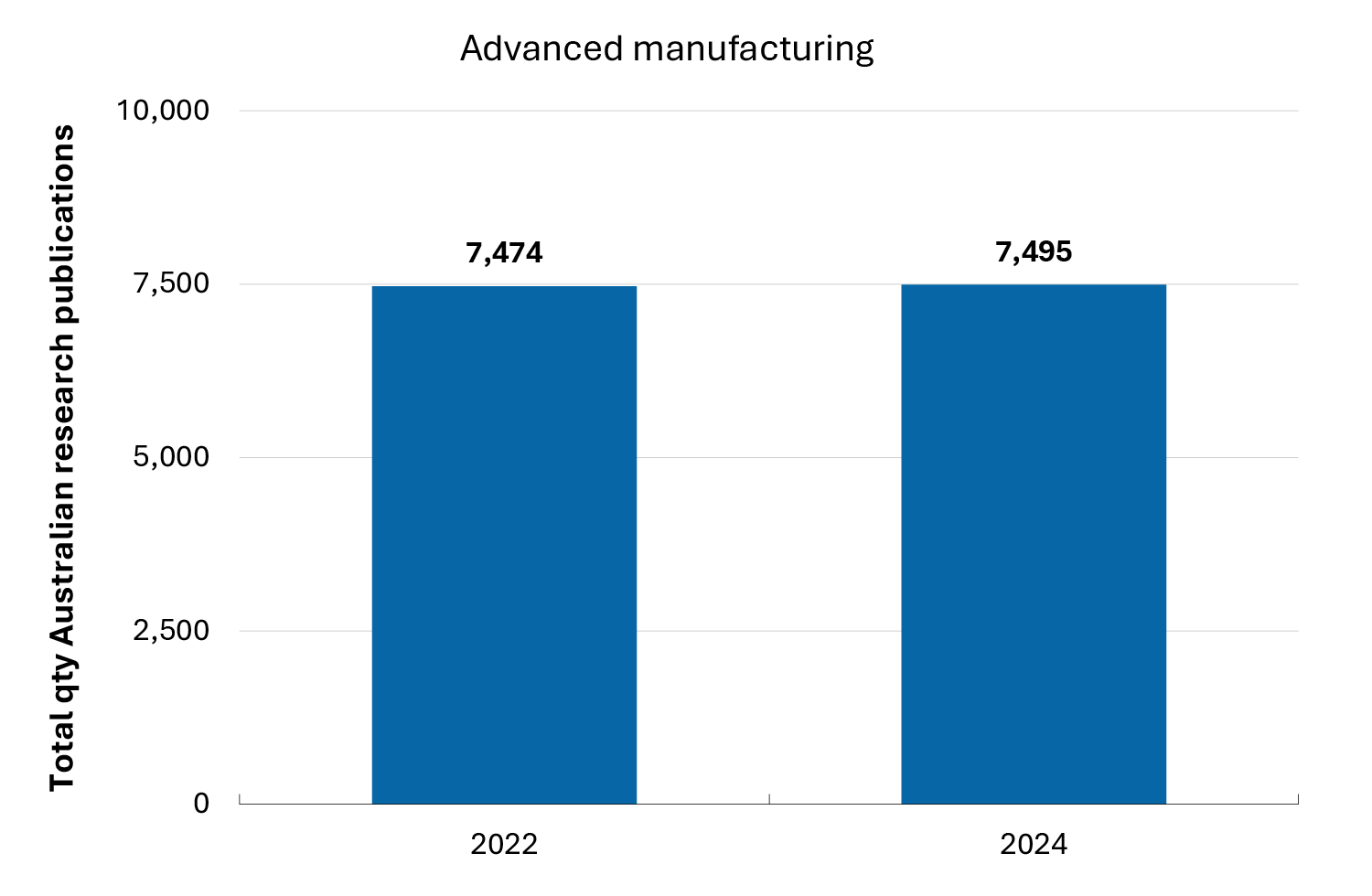
From 2022 to 2024, Australia’s research trends are consistent across critical technology fields. Advanced manufacturing and materials technologies have seen a slight increase in publications. 

Research quality remained the same from 2022 to 2024. Quality is defined as the percentage of publications in the top 10% most cited publications in the field.

Research specialisation shifted slightly lower from 2022 to 2024. We define specialisation as the ratio of the share of a field in the publications that come from a given country to the share of the same field in the global total of publications.

See next tab.

Australian research publications for advanced manufacturing and materials technologies field, 2022–2024. 

Total quantity of Australian publications in advanced manufacturing
  2022 2024
Publications 7474 7495

Patent trends 

Intellectual property (IP) rights are vital to supporting translation of critical technology research outcomes into products, businesses and new capabilities. 

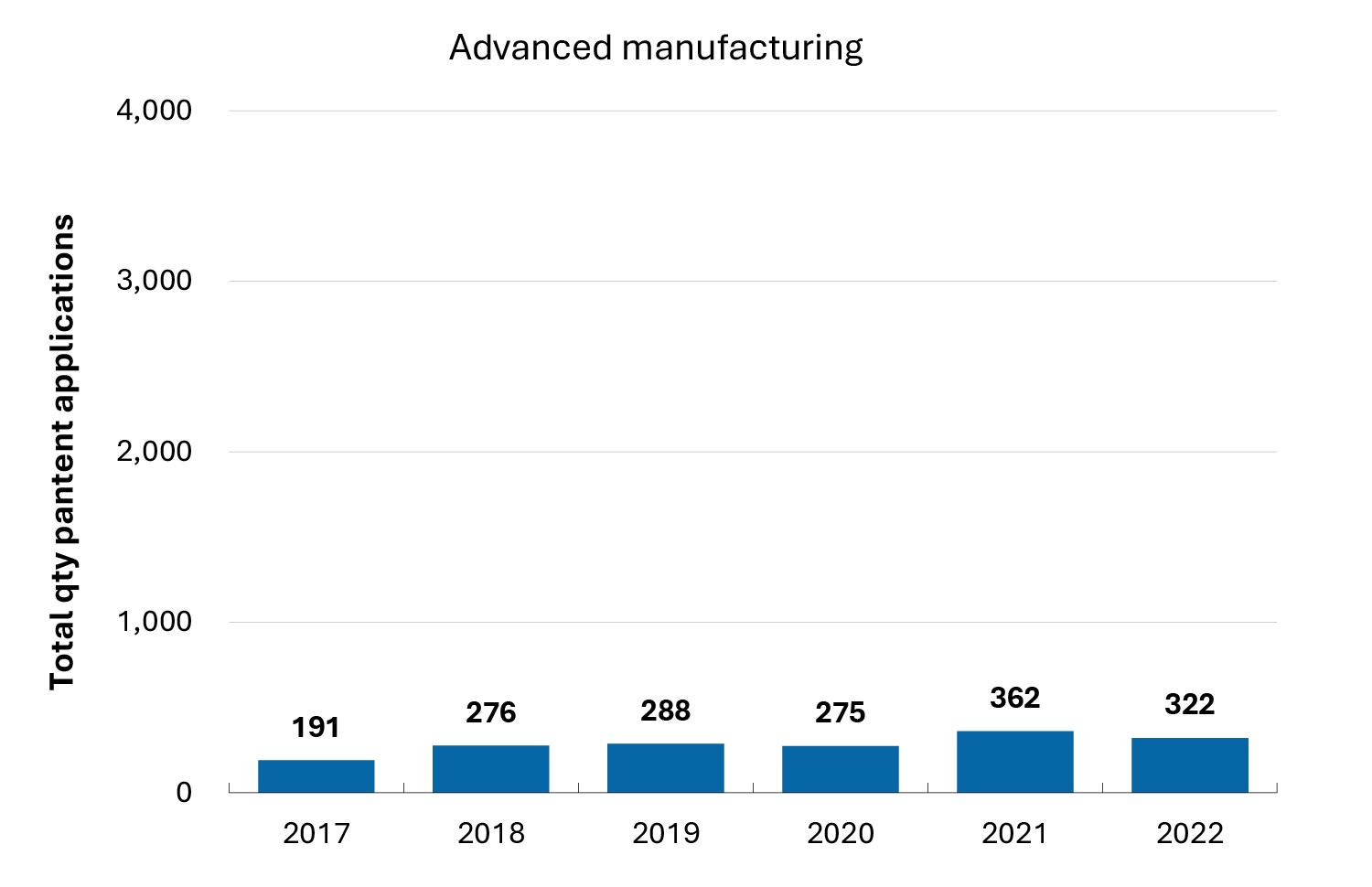
Advanced manufacturing and materials technologies (standard) patent applications grew from 2017 to 2019 with a slight drop off in 2020. This drop-off then rebounded in 2021. 

See next tab.

Advanced manufacturing and materials technologies (standard) patent applications in Australia, 2017–2022.

Advanced manufacturing and materials technologies (standard) patent applications in Australia, 2017–2022
  2017 2018 2019 2020 2021 2022
Patent applications 191 276 288 275 362 322

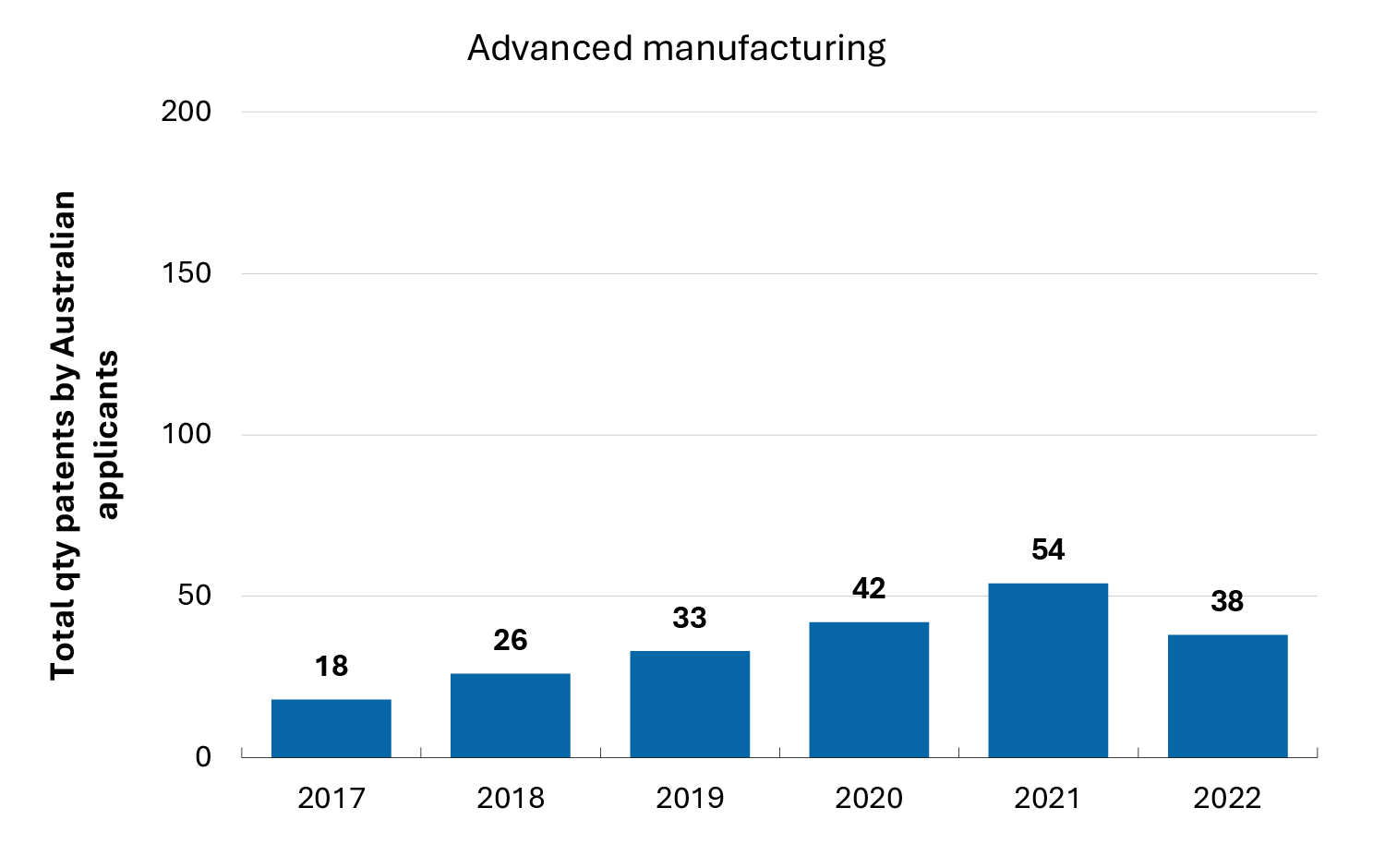
Advancing manufacturing and materials technologies (standard) patent applications by Australian applicants grew slightly from 2017 to 2021 with a slight decrease in 2022.

See next tab.

Advancing manufacturing and materials technologies Australian applicant (standard) patent applications in Australia, 2017–2022.

Advancing manufacturing and materials technologies Australian applicant (standard) patent applications in Australia, 2017–2022
  2017 2018 2019 2020 2021 2022
Patent applications 18 26 33 42 54 38

Venture capital trends 

Venture capital (VC) investment data can help assess Australia’s critical technology capability. The data acts as a real-time signal of where private investment is supporting innovation. 

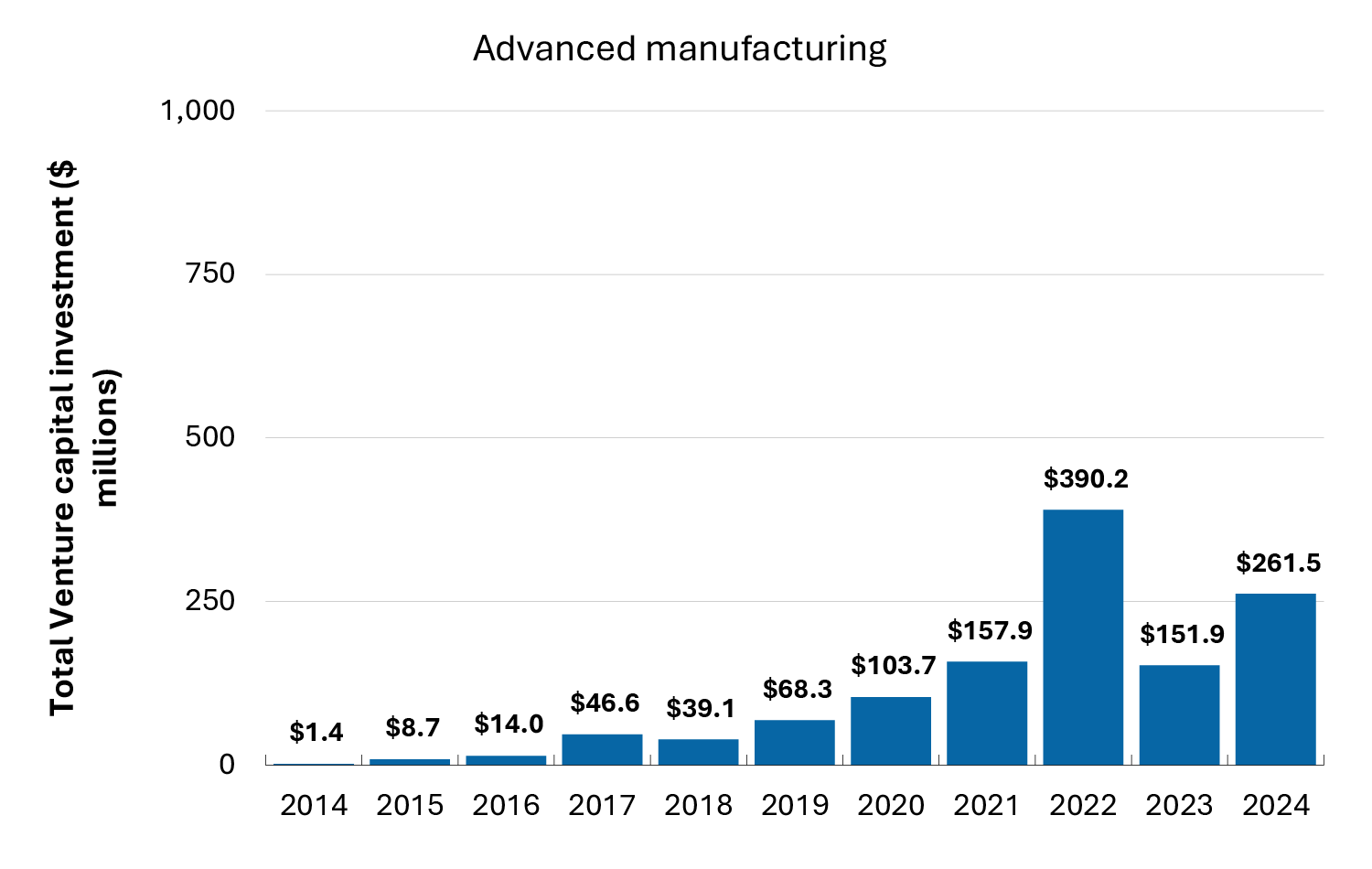
Overall VC investment in Australian advanced manufacturing and materials technologies critical technology firms increased in 2024. Global trends underpinned by inflation, economic tension and global conflicts may attribute to the falls in 2023.

See next tab.

Venture capital investment in Australian advancing manufacturing and materials technologies firms, 2014–2024.

Venture capital investment in Australian advancing manufacturing and materials technologies firms, 2014–2024
Year VC investment in $millions
2014 1.35
2015 8.65
2016 14.03
2017 46.63
2018 39.07
2019 68.32
2020 103.72
2021 157.92
2022 390.18
2023 151.9
2024 261.5
Total 1243.27

The future

Advanced materials will underpin new technologies that can be tailored to specific business needs. They will make industries more sustainable by helping businesses improve their energy efficiency and reduce emissions. The sectors that stand to benefit the most are:

  • construction  
  • energy
  • biomedicine
  • aerospace.

While Australia is a leader in advanced material research and development, we need more investment and expertise to commercialise these solutions.

Strengthening Australia’s advanced materials and manufacturing capabilities will also help us tackle the economic and supply chain challenges we face. Otherwise, we will be dependent on fragile supply chains and exposed to geopolitical shocks.

Data sources

CSIRO collected all publication data from Web of Science systems and covers 2022 and 2024.

We sourced all patent data from IP Australia. The data covers 2017 to 2022 for standard patent applications filed in Australia. It does not include innovation patents, following a 2022 review phasing them out. We note innovation filings were on the rise during this period, which led to a spike in the years leading up to ceasing. 

DISR collected all VC data in March 2025 using Pitchbook and covers 2014 to 2024.