Australia has unique characteristics, credentials, capabilities and partnerships that enable us to play a leading role in the development of globally secure, resilient and diversified critical minerals supply chains. We will work with communities, key sector participants and international partners to fully realise this potential.
Why the opportunity matters for Australia
Demand for critical minerals remains strong and continues to increase as partners decarbonise their economies, strengthen their economic resilience, develop digital infrastructure and artificial intelligence capabilities as well as other modern and advanced technologies. Access to these minerals is increasingly central to many countries’ industrial capabilities and national security, including Australia’s, but is becoming harder to secure as export controls and other restrictions disrupt supply. Government strategy and policy action are now necessary tools to reduce Australia’s exposure to volatile and concentrated supply chains.
Market conditions vary by critical mineral and change in response to a range of factors. Some markets operate with greater transparency, while other critical minerals markets remain highly concentrated, opaque and exposed to sharp price movements. These risks extend beyond extraction. Some of the most significant vulnerabilities are in refining, processing and other midstream segments, where capability is concentrated in a small number of countries. Across lithium, nickel, cobalt, battery-grade graphite and rare earth element refinement, the 3 largest refining economies accounted for an average of around 91% of global supply (IEA 2026a). In several markets, including for manganese, nickel and graphite, virtually all supply growth came from a dominant supplier (IEA 2026b).
This concentration means supply chain disruptions, including through the use of export controls or other trade restrictions can create strategic pressure points across global markets, increasing exposure to price shocks and coercive market behaviour. Current trends suggest little improvement over the coming decade. The consequences of this are increasingly significant, with analysis indicating disruptions to rare earths supply chains alone due to export controls could place up to around $9 trillion per year in downstream industrial production at risk (IEA 2026b). Such disruptions would have far reaching implications for energy security, defence supply chains and industrial production globally.
These vulnerabilities are becoming more consequential as demand for critical minerals continues to grow. Lithium demand is projected to be 3.8 times higher in 2040 than in 2025, with mined output required to increase by 2.5 times from current levels to meet this projected demand (IEA 2026b). Global demand for magnet rare earths is set to expand by 25% between 2030 and by over 80% to 2050 (IEA 2026b). However, these strong projections do not guarantee the investment required to deliver future supply and meet demand. Investment and diversification challenges are particularly acute in processing and refining, where concentration constrains access to supply even when upstream resources are available and abundant.
Geopolitical tensions, strategic competition and trade fragmentation are further shaping critical minerals markets. As countries seek to strengthen economic, industrial and national security, critical minerals are increasingly important strategic assets. Australia’s approach reflects this. Governments across the world have recognised their exposure to supply chain disruption risks and are reducing their dependence on single suppliers. Inaction is no longer a viable option.
Governments are responding by implementing policies such as public financing, project facilitation, domestic processing support, permitting reforms, strategic reserves and increased international cooperation. Governments and industry are looking at ways to secure, diversify and operate in more transparent supply chains, particularly in the midstream part of the value chain.
Growing Australia’s critical minerals sector will strengthen supply chain resilience and contribute to diversifying global sources of supply. This supports both Australia’s interests and the needs of our partners. To achieve this, we will:
- strengthen international partnerships to help bring new sources of demand online
- coordinate, de‑risk and provide targeted financing to specific projects
- monitor and determine the most suitable policy settings to grow the sector
- facilitate international investment and strategic offtake agreements to diversify supply.
Australia’s critical minerals opportunity
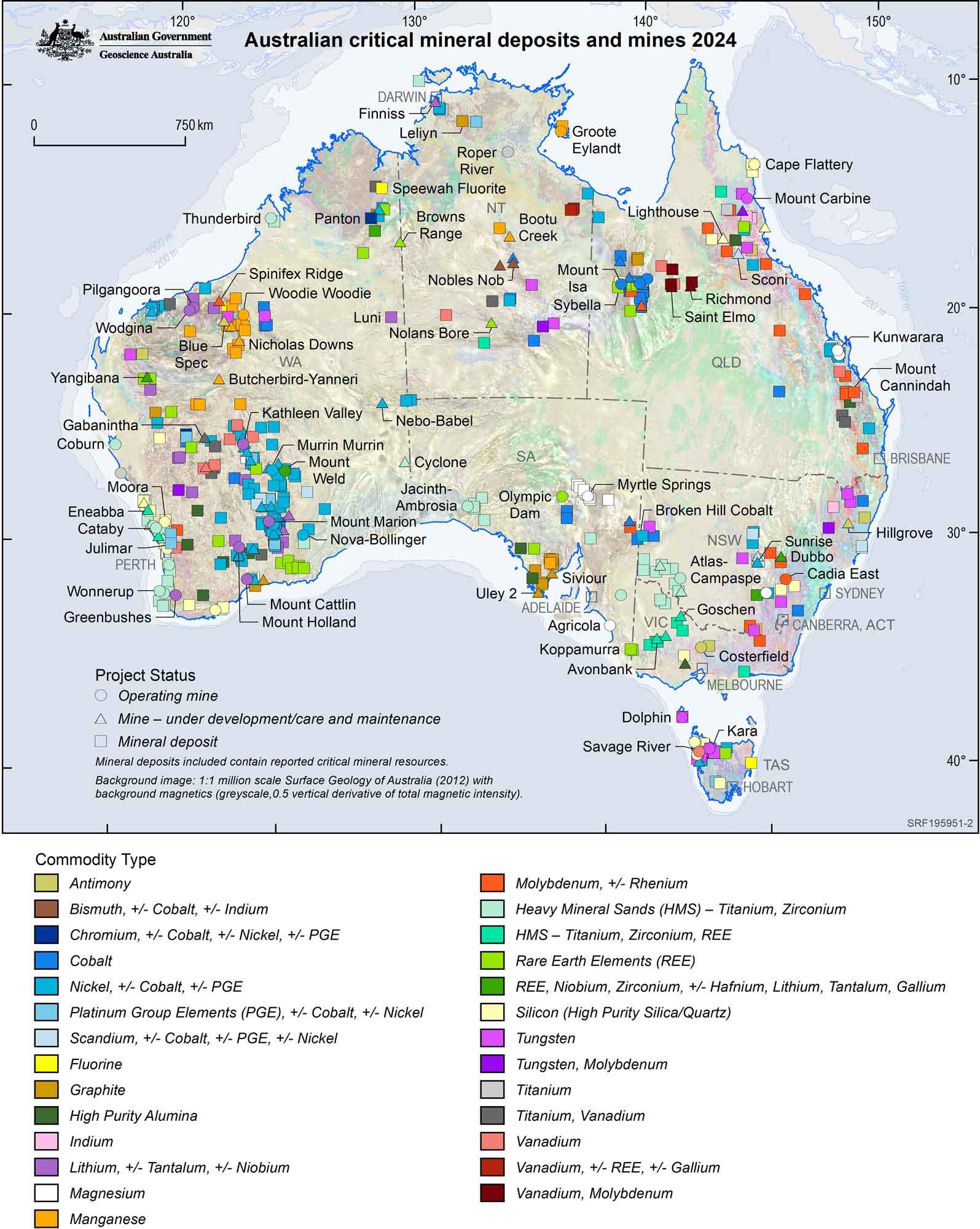
Australia has some of the world’s largest recoverable resources of critical minerals, including cobalt, lithium, manganese, rare earth elements, tungsten and vanadium (see figure below, Geoscience Australia 2026). We also have deep expertise in traditional resources, built over generations as a reliable resources exporter, with a globally recognised mining sector, world-leading geoscience capability, and skilled workforce. These strengths position Australia to seize the critical minerals opportunity, including capturing greater value across the value chain.
However, our geology and mining expertise alone will not be enough to counter concentrated market power and behaviour that undermines fair competition. Australia must prioritise minerals and supply chain segments that matter most to our strategic interests. We will focus effort where supply risks are greatest, market conditions are most distorted, and Australia has the capability to make a material contribution. This means we will target areas where our resource strengths, partner demand and national security and economic resilience interests align.
Australia can build from the industrial capability we already have, while attracting investment in new midstream processing assets for critical minerals. For example, existing smelters and refineries can provide a platform for further value‑adding, including recovery of critical minerals from processing streams, by‑products and residues where commercially viable. New processing assets and common user facilities can also create pathways to process more Australian minerals onshore. Maintaining, modernising and expanding competitive processing capability will enable Australia to capture more value domestically and strengthen secure, resilient and diversified critical minerals supply chains.
Many of our partners have well established manufacturing and downstream processing capabilities. Australia can better connect our upstream resources, and growing midstream outputs, with our partners’ demand to help deconcentrate global markets. This will create new pathways for Australian industry to participate in strategically important value chains. These partnerships will attract investment, secure offtake opportunities and build the commercial scale needed to develop upstream and midstream projects.
Australia is already seeing early signs of this in practice. Since the release of the 2023 strategy, 15 new critical minerals projects and major expansions to existing operations have commenced production, adding around $6.3 billion in annual production value, with around $4 billion in downstream capital investment*. Refining projects have also accounted for 67% of the value of critical minerals final investment decisions, compared with 31% prior to the strategy’s release (Department of Industry, Science and Resources analysis). Continuing this momentum will allow Australia to capture greater economic and strategic value from our resources over time.
Australia’s project pipeline lays a strong foundation to act on these opportunities. In December 2025, our pipeline comprised 130 major critical minerals projects. This included approximately $19 billion in proposed investment for projects at more advanced stages of development (Office of the Chief Economist, 2025). This pipeline is dominated by early-stage projects. Translating this pipeline into production will require targeted and strategic investment, supported by the Commonwealth, state and territory governments, international partners and the private sector.
* Department of Industry, Science and Resources analysis: Albermarle Kemerton Lithium Refinery Train 1–2 (lithium hydroxide); Core Exploration Ltd Finniss Lithium project Stage 1 (spodumene concentrate); Covalent Lithium Kwinana Lithium Refinery (lithium hydroxide); Covalent Lithium Mount Holland lithium mine (spodumene concentrate); Group 6 Metals Dolphin Project (tungsten trioxide); Iluka Resources Balranald (ilmenite concentrate); Iluka Resources Balranald (rutile concentrate); Iluka Resources Balranald (zircon concentrate); Liontown Resources Ltd. Kathleen Valley (spodumene concentrate); Lynas Rare Earths Ltd. Kalgoorlie Rare Earth Processing Facility (NdPr carbonate); Sheffield Resources/Yansteel Thunderbird Stage 1 (ilmenite concentrate); Sheffield Resources/Yansteel Thunderbird Stage 1 (zircon concentrate); Tronox Atlas-Campaspe (ilmenite concentrate); Tronox Atlas‑Campaspe (rutile concentrate); Tronox Atlas-Campaspe (zircon concentrate).