Transcript
[Music plays and an image of the Prime Minister’s Prize for Aboriginal and Torres Strait Islander Knowledge Systems medallion appears on the left. The Coat of Arms and text appears on the right: 2026 Prime Minister’s Prize for Aboriginal and Torres Strait Islander Knowledge Systems.]
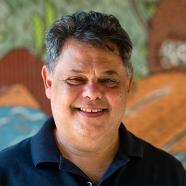
[Image changes to show the medallion in the centre and a photo of Professor Christopher Matthews can be seen on the right of the medallion. Text appears: Professor Christopher Matthews BSc (Hons) PhD FSTE.]
[Image of tree branch moving in breeze, followed by close shot of beach vegetation and a crow flying from a tree top.]
Professor Christopher Matthews: Aboriginal knowledge systems are always about understanding all the interconnections. So it's a much bigger picture.
[Image shows Chris sitting on a chair being interviewed in-front of a mural. Text appears: Professor Christopher Matthews.]
My name is Chris Matthews. I come from the Quandamooka people of the Moreton Bay region near Brisbane.
[Image shows Chris walking along beach during the day.]
I am an Industry Professor at the University of Technology Sydney.
[Image changes to Chris sitting on a chair being interviewed in-front of a mural.]
I am working with many communities across Australia to look at the connection between mathematics and culture to improve the education of Aboriginal kids across Australia.
[Image shows a close shot of Chris in an outdoor setting. Images change to Yalmay Yunupiŋu from Yirrkala Bilingual School. She is gesturing and talking to unseen person outdoors. Images move through to show Chris sitting and laughing with people outdoors and then Chris seated being interviewed in-front of a mural.]
So the Goompi model is a model of connecting culture. What it does for teachers can actually be used to give more culturally responsive maths lessons within the classroom.
[Image shows close video portrait of Merrki Ganambarr, a teacher linguist from Yirrkala Bilingual School, looking directly at the camera. Images move to show Chris talking to the camera then to Merriki and Chris sitting with a group of people at the beach. Image then changes back to Chris sitting on a chair being interviewed in-front of a mural.]
I've had the privilege of working with the Yolngu people in East Arnhem Land, in Yirrkala. In the 80s, Mandawuy Yunupingu, who was the principal of the school, he said the closest connection between Yolngu knowledge and Western knowledge was mathematics. And he also said that our mathematics is Gurrutu.
[Image shows close video portrait of Yalmay Yunupiŋu from Yirrkala Bilingual School, looking directly at the camera. Image changes to a close shot of learning resource on the ground with Yolngu language words visible. Image then changes to Chris sitting on a chair being interviewed in front of a mural.]
So Gurrutu is the kinship system. What's important about the kinship system is, mathematically, it's an Abelian group in group theory. But we can actually use that structure to then strongly connect the knowledges to algebra, to then teach algebra through that lens.
[Image changes to show Merrki Ganambarr and Yalmay Yunupiŋu sitting side by side on rocks by the beach, responding to interview questions.]
Merrki Ganambarr: What Chris did was to have the Gurrutu maths system of looking at the world into balanda mathematics. And so, by studying together, we are starting to connect the 2.
[Image shows Chris seated being interviewed in-front of a mural. Image changes to group of people, including Chris and 3 Yolngu women, standing together on the beach. Image then changes to a close shot of a stick dragging across the sand.]
Professor Christopher Matthews: When kids can see their own culture in the classroom, they do see things differently. It's really about them feeling comfortable and connected.
[Image shows close shot of lines and marking drawn in the sand.]
They've shifted from head on the table to actually sitting upright and engaging.
[Image shows Chris sitting on a chair being interviewed in-front of a mural. Image changes to a shell being placed on sand, other markings and shells on the sand. Image changes to Chris talking at the beach then to Merrki talking to someone and gesturing at the beach.]
Ever since I developed the Goompi model, it has actually grown. Within a short period of time, people started to pick on up on it as a different way of teaching.
[Image shows Chris sitting on a chair being interviewed in-front of a mural. Image changes to close shot of Yalmay looking at the horizon.]
It's got to the stage now where many people are using it. Universities are teaching it.
[Image shows wide shot of Chris and 3 Yolngu woman sitting side by side with their backs to the camera watching the sunset in the far distance. Image changes to Chris sitting on a chair being interviewed in-front of a mural. Image changes to aerial shot of cultural markings made in the sand.]
If we can actually build stronger connections between them and work together with these 2 knowledge systems, then I believe there could be more advancements for us as Australians within this country.
[Music plays and the image changes to show the Prime Minister’s Prize for Aboriginal and Torres Strait Islander Knowledge Systems medallion on the left. The Coat of Arms and text appears on the right: 2026 Prime Minister’s Prize for Aboriginal and Torres Strait Islander Knowledge Systems.]