Transcript
[Music plays and an image of the Prime Minister’s Prize for Science medallion appears on the left. The Coat of Arms and text appears on the right: 2026 Prime Minister’s Prize for Science.]
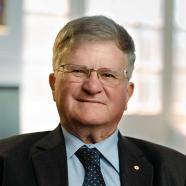
[Image changes to show the medallion in the centre and a photo of Professor Anthony Thomas can be seen on the left of the medallion. Text appears: Professor Anthony Thomas AC FAA.]
Professor Anthony Thomas: I was excited about physics at high school, by things as simple as how a lever worked.
[Image changes to show Anthony standing on a balcony of a university building looking out, and then image changes to show a view of Adelaide University.]
You know the famous quote, ‘Give me a lever long enough and I'll move the world.’
[Image changes to show Anthony talking to the camera, and text appears: Professor Anthony Thomas AC]
I'm Anthony William Thomas. I work at Adelaide University.
[Image changes to show a close side view of Anthony talking to the camera.]
I'm Elder Professor of Physics and I'm fascinated by the structure of matter at its deepest level.
[Images move through to show a view of diagrams on a computer screen, Anthony looking at the screen, and then Anthony talking to the camera.]
The cloudy bag model was probably the most important thing done in the early part of my career.
[Images show Anthony working on the computer, and closer views of Anthony’s face and the computer screen he is viewing.]
It presented a new way of looking at the internal structure of the proton.
[Images show Anthony talking to the camera, a close view of a computer screen and Anthony in conversation.]
The predictions of the model led to many experiments around the world and in modern times, an underlying theoretical framework to understand the results of supercomputer calculations of quantum chromodynamics.
[Images show Anthony talking to 2 students looking at computers, the screen behind Anthony with diagrams on it, and the students talking one after the other.]
We have these amazing objects, neutron stars, the most dense matter in the universe.
[Images show Anthony talking to the camera, and views of Anthony working with students.]
We predicted that you could have strange particles in the core of the neutron star, but the mass could be as high as twice the mass of the sun.
[Image changes to show Anthony talking to the camera.]
Three years later, the first neutron star with a mass that high was discovered.
[Images show Anthony and a student looking at formulas on a whiteboard, a hand writing on the whiteboard, and a view of Anthony and the student.]
I'm involved in theoretical ideas of what dark matter might be.
[Images show various views of Anthony talking to the camera]
The dark photon is just one possible theory through which dark matter might interact with our world.
[Images show Anthony and a student looking at a whiteboard, close views of the student, notes on the whiteboard, and then Anthony talking to the camera.]
If we're ever going to see it and understand what dark matter is, we need to be able to probe it in experiments.
[Image shows a sign for the ‘Special Research Centre for the Subatomic Structure of Matter’. Image changes to Anthony and a colleague walking down a corridor, and then Anthony talking to the camera.]
The Centre for the Subatomic Structure of Matter has provided an incredibly rich environment for our students, for our research fellows and for our staff.
[Images show 2 students, Anthony talking with the students, a graph on a computer screen, and views of Anthony talking to the camera.]
I would hope that the students who have worked with me take a fascination with the universe and a wish to understand how it works at the deepest level.
[Images show Anthony talking with 2 students, and then focus on Anthony.]
Being the recipient of the Prime Minister's Prize for Science is a great honour.
[Images show Anthony and 2 students walking through the grounds of the University, Anthony working with 2 students, and then Anthony smiling at the camera.]
It's a recognition of my efforts, but it's also a recognition of the contributions that have been made by many students and colleagues with whom I've had the pleasure to workover many decades.
[Music plays and the image changes to show the Prime Minister’s Prize for Science medallion on the left. The Coat of Arms and text appears on the right: 2026 Prime Minister’s Prize for Science.]