
National Science Week is an important part of the Australian Government’s approach to science engagement and inspiring an interest in STEM for all Australians. This year’s event has more than 2,500 in-person and online events to excite people of all ages to attend and participate.
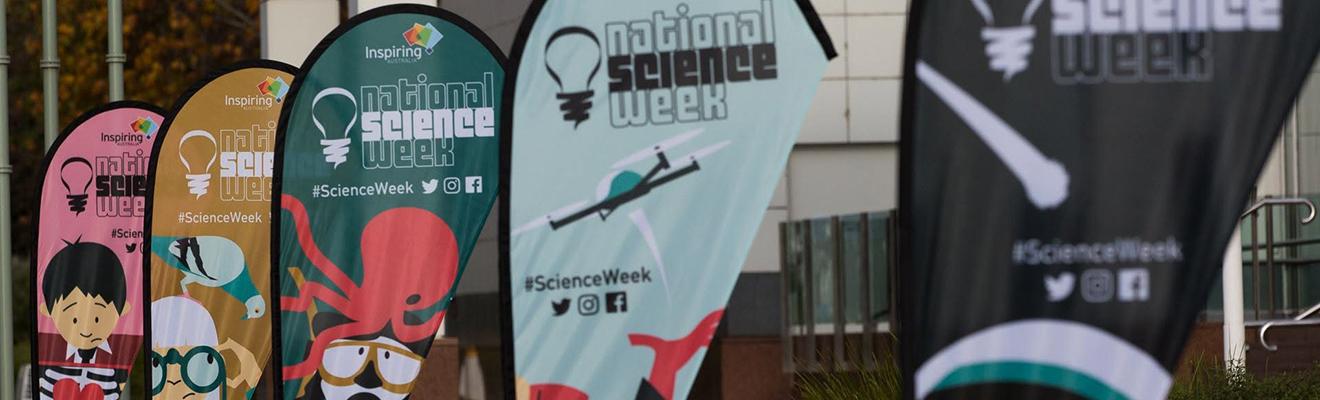
Image provided by Questacon
Some events we funded
This year our department funded 28 events with $500,000 in grants around Australia. Some of the events and exhibitions we funded include:
- In the ACT, the Malunggang Connections: Science, Culture and Community Through Platypus event has activities involving platypus (malunggang) and native water rats (rakali). These will include a film screening, guided platypus walks, water bug hunt demos and a First Nations symposium on the platypus and aquatic science.
- In New South Wales, the Quantum Future Talent: Engage, Connect and Inspire event will introduce quantum technology to young students and the public. You can enjoy hands-on demonstrations, inspirational talks and interactive exhibits.
- In the Northern Territory, the Science for Health: Climate and Health Awareness in Remote Australia is an interactive STEM open day in remote Central Australia. The event will include hands-on activities, a solar centre tour and a session on antimicrobial resistance. These encourage STEM participation, environmental awareness and health literacy among remote residents. Australian climate scientists will also hold inspiring talks to showcase future pathways for youth to pursue careers in science.
- In Queensland, the Brains, Boots & Beyond: Exploring Sports Psychology in VR event involves an interactive VR installation. You can go inside the brain of an elite athlete to explore neuroscience, sports psychology and wellbeing.
- In South Australia, the Future Minds: Creativity and Ethics in the Age of AI event will show the human side of artificial intelligence. Four high-impact events will encourage community members of different ages and backgrounds in metro and regional areas to discuss good and bad aspects of AI. Students will also take part in interactive workshops, giving young people the opportunity to engage directly with AI.
- In Tasmania, the Beaker Street Festival is celebrating its 10th year. The festival invites diverse audiences to share in immersive experiences, crucial conversations, and innovative events and exhibitions at the intersection of science and art. More than 200 scientists take part through a range of fascinating main stage presentations, expert-led field trips, hands-on workshops and intimate dinners and tours. There are Antarctic encounters at the ‘Hobartica’ precinct and the festival’s signature Roving Scientist Bar where everyone's invited to take part in the conversation.
- In Victoria, the Remnant (by artists Charlie Lawler and Wona Bae) is an interdisciplinary exhibition and public art project highlighting the grey-headed flying fox and its vital role in biodiversity. The project integrates Indigenous Knowledge and scientific expertise, inviting audiences to connect with environmental science through creativity. The temporary public art component is activated through transmedia storytelling, immersive installations, digital simulations and citizen science.
- In Western Australia, the Forrest Research Foundation National Science Week Showcase event will include hands-on science stations covering everything from bee hotels, a healthy heart experiment, a molecular VR experience and a black hole hunt. The organisers will also collaborate with the Supersonic Science professional edutainment team to deliver a full-package expo for the whole family.
Our portfolio agencies’ events
Some of our portfolio agencies are hosting exciting events open to the public.
- Questacon is the lead agency for National Science Week. They register, organise and support events and activities across Australia, online, on podcasts, radio or in-person. They also provide resources such as DIY science activities, trivia quizzes and other materials that people can use to organise their own events.
- The Australian Space Agency (ASA) is organising several events such as:
- Plants in Space: Mission to the Moon workshop, in collaboration with the ARC Centre of Excellence in Plants for Space, places attendees in the shoes of plant scientists, psychologists, food chemists and more to prepare a plant-inspired solution for a space mission.
- Mission Possible: The Stories of Us is a series of collaborative events with the Japan Aerospace Exploration Agency, Japanese universities and the Australia-Japan Foundation celebrating 50 years of partnership. Events are planned across multiple Australian cities (Adelaide, Canberra, Melbourne and Sydney).
- General Relativity for Youth-Stretchy Spacetime workshop gets attendees hands-on with one of the universe’s most powerful forces as they build their own ‘gravity well’ and experiment with how planets and objects move through space.
- Sketch-bot drop-in day will allow visitors to the Australian Space Discovery Centre to have their portrait drawn by one of ASA’s ‘Sketch-bot’ robot arms. Visitors can snap a photo and watch as the robot calculates the optimal path to sketch their likeness!
- Pacific Airshow – Next Gen STEM Lab (Student with Altitude Day) event at the Gold Coast will give students a chance to check out flight simulators and experience interactive challenges. Students will engage with real-world technology and discover pathways into future careers in STEM. As part of the program, students will hear from 2026 Australian of the Year and astronaut Katherine Bennell-Pegg. Registrations for this event are closed and ASA is expecting around 6,000 students to attend.
- Seeds of Science: How Australian Seeds Travelled to Space and Back Again is a webinar presented by Dr Sara Webb, Swinburne University, Nat Science Week Ambassador. It shows the incredible journey of Australian seeds that travelled to the International Space Station and back as part of Mission Sprouts. This interactive livestream will also feature a special pre-recorded message from 2026 Australian of the Year and astronaut Katherine Bennell-Pegg.
- CSIRO’s robotics experts will host a couple of events:
- CSIRO Robot Responders will give young people the chance to explore how people design and use robots in the real world.
- National Science Week Storytime will feature ‘Bear to the Rescue’.
- The Australian Nuclear Science and Technology Organisation (ANSTO) will partner with Deaf Youth Australia to run a 4-day science camp for up to 20 deaf and hard-of-hearing youths.
- The National Measurement Institute (NMI) will host the annual Measurement Awards recognising outstanding achievements in measurement science. You can join and vote in the People’s Choice awards.
Featured video
The 2025 Prime Minister’s Prizes for Science recipients share what they love about science for National Science Week!
Show transcript
[Music plays and an image of Mrs Paula Taylor, recipient of the 2025 Prime Minister’s Prize for Excellence in Science Teaching in Primary Schools appears on the screen. She is first shown talking to the camera in a classroom, then shown talking in front of students in a class.]
Paula Taylor: My love for science began in year 11 when I was inspired by a teacher.
[Image on screen shifts to Mr Matt Dodds, recipient of the 2025 Prime Minister's Prize for Excellence in Science Teaching in Secondary Schools. He is first shown talking to the camera in a classroom. The image then shifts to him talking in front of his students in a classroom and finally somewhere outdoors.]
Matt Dodds: I’ve always been passionately curious about how the universe works and how things work at a deeper level.
[Image on screen shifts to Dr Nikhilesh Bappoo, recipient of the 2025 Prize for New Innovators. He is first shown talking to the camera in an empty office. The image then shifts to show him working on a motherboard and looking at a part closely.]
Dr Nikhilesh Bappoo: I was the kind of person that would break toys. I would take out the electronics and study them and try to come up with different contraptions.
[Image on screen shifts to Distinguished Professor Lidia Morawska, recipient of the 2025 Prime Minister’s Prize for Science. She is first shown talking to the camera in a room, then the image shifts to her and another researcher looking at an aerodynamic particle machine while talking to each another.]
Prof Lidia Morawska: For me, it was the deepest secrets, going down to the atoms, to the nucleus.
[Image shifts to Professor Michael Wear, the first recipient of the Prime Minister’s Prize for Aboriginal and Torres Strait Islander Knowledge Systems. He is first shown walking on a beach, then the image shifts to him talking to the camera in an office.]
Prof Michael Wear: Indigenous people, we’re curious and we like to observe nature.
[Image shifts to Dr Yao Zheng, recipient of the 2025 Malcolm McIntosh Prize for Physical Scientist of the Year. He is shown talking to the camera in a laboratory.]
Prof Yao Zheng: I think the most important thing is to keep curious.
[Image shifts back to Paula Taylor who is in a lab or classroom. She is first shown in the lab labelling two bottles with contents inside them. Next, she is shown in a lab with her students where she is transferring the liquid content of a beaker to another bottle.]
Paula Taylor: Studying science really had me hooked on what was possible.
[Image shifts to Dr David Khoury, recipient of the 2025 Frank Fenner Prize for Life Scientist of the Year. He is first shown talking to the camera in a meeting room with rows of chairs. The image then shifts to him writing formulas on a glass board and finally shifting to him talking to someone working in a lab.]
Dr David Khoury: I realised I was much more inspired by the challenge of trying to do something that affected people for the better with maths.
[Image shifts back to Prof Lidia Morawska talking to the camera in a room. Image then shifts to her looking up at a screen.]
Prof Lidia Morawska: Research is a journey. It changes, so we start seeing different horizons, which we didn't see before.
[Image shifts to Dr Vikram Sharma, recipient of the 2025 Prime Minister’s Prize for Innovation. He is shown talking to the camera in a boardroom, then him talking with a group at a board room table and holding up a motherboard. He is then shown talking to a female colleague while showing a motherboard. The image shifts to him talking to a male researcher while gesturing towards computer equipment on a table, then finally shifts to him talking to the camera.
Dr Vikram Sharma: A career in science can give you a lifetime of opportunities to explore ideas that have often not been thought of anywhere else in the world.
[Image shifts back to Paula Taylor talking to the camera in a classroom.]
Paula Taylor: Have a look around, there’s a science event happening near you. Enjoy the science in your community and have a happy National Science Week.
[Music ends. The final panel shows the text ‘National Science Week 2026’. Around the text are a series of illustrated characters from the official National Science Week brand, all doing a variety of science activities. The Australian Government official crest is shown at the bottom centre of the screen with the text ‘Australian Government Initiative’. Next to the crest is the official Inspiring Australia text and logo.]
[Video ends.]
Recipients in order of their appearance in the video are:
- Mrs Paula Taylor – 2025 Prime Minister’s Prize for Excellence in Science Teaching in Primary Schools
- Mr Matt Dodds – 2025 Prime Minister's Prize for Excellence in Science Teaching in Secondary Schools
- Dr Nikhilesh Bappoo – 2025 Prize for New Innovators
- Distinguished Professor Lidia Morawska – 2025 Prime Minister's Prize for Science
- Professor Michael Wear – 2025 Prime Minister’s Prize for Aboriginal and Torres Strait Islander Knowledge Systems
- Professor Yao Zheng – 2025 Malcolm McIntosh Prize for Physical Scientist of the Year
- Dr David Khoury – 2025 Frank Fenner Prize for Life Scientist of the Year
- Dr Vikram Sharma – 2025 Prime Minister’s Prize for Innovation.