Resources and energy quarterly: June 2026

Date published:
3 July 2026

The June 2026 Resources and energy quarterly (REQ) contains the Office of the Chief Economist’s forecasts for the value, volume and price of Australia’s major resources and energy commodity exports.

The publication provides:

  • a 5-year outlook for global commodity prices, demand and supply
  • up-to-date global production and consumption data
  • forecasts for Australian production, exports, volumes and prices of key resources and energy commodities
  • detailed statistical tables.

Overview

Since the December 2025 Resources and energy quarterly (REQ), forecasts for Australia’s resource and energy commodity exports in 2025–‍26 and 2026‍–‍27 have been revised up sharply. Driving the upgrade has been higher-than-expected prices for energy commodities –‍ due to supply disruptions in the Middle East –‍ and ongoing strong gold prices. Export earnings are expected to fall modestly by 2030–31 as earlier upward revisions in 2025–‍26 and 2026‍–‍27 unwind.

  • The outlook for Australia’s exports of resource and energy commodities is stronger than at the time of the December 2025 REQ report. Resource and energy exports are now estimated to have risen to around $405 billion in 2025–26 from $385 billion in 2024–25 and are forecast at $416 billion in 2026–27. Exports are forecast to fall to $371 billion ($325 billion in real terms) in 2030–31.
  • World economic growth is expected to be 3.1–3.2% over the 5-year outlook period, similar to pre-pandemic growth rates. The Strait of Hormuz blockade and shifting trade barriers will detract from world growth in the short term, while easier fiscal policy and strong investment will support activity. Investment will be driven by rising artificial intelligence (AI) usage and data centre investment, efforts to boost supply chain security and the global energy transition.
  • Within the resource and energy commodity exports, gold exports are forecast to peak at $73 billion in 2026–27. But iron ore will remain our biggest export over the outlook period. Our low production costs and proximity to the fast-growing Asian region will help Australia compete against rising Brazilian and Guinean iron ore output.

This publication assumes a near term resolution of disruptions in the Middle East as the central scenario.

An alternative scenario, where trade disruptions continue for several more months, leads to longer and higher prices for energy commodities. In the alternative scenario, the longer period of elevated prices leads to stronger export earnings for Australian energy commodities.
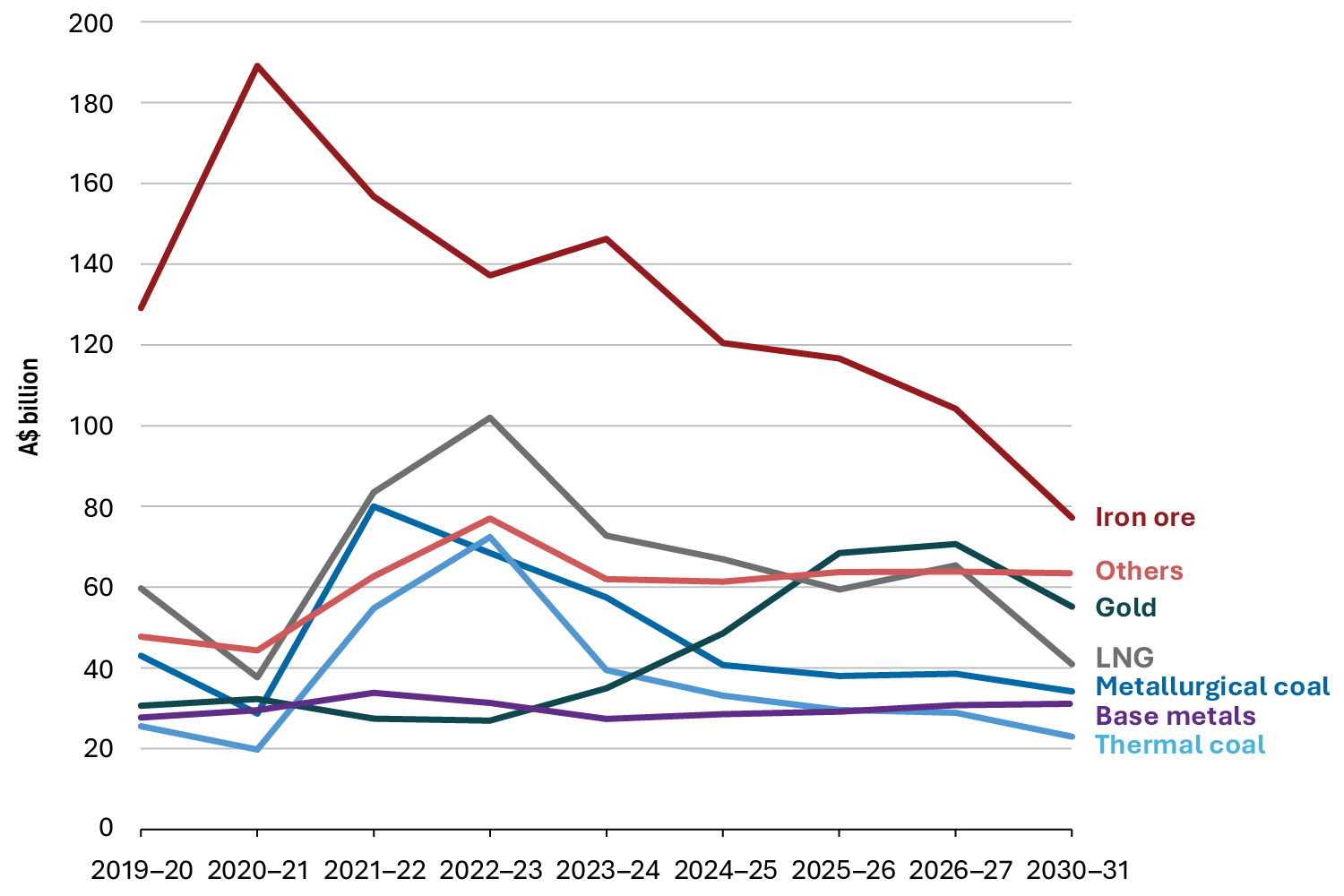
REQ June 2026 chart - commodity values

Macroeconomic outlook

Global growth in 2026 is forecast to be 3.1% to 0.2 of a percentage point decrease from the previous forecast, and 3.2% (unchanged from the previous forecast) in 2027. Global growth in 2026 is forecast to be 3.1% (a 0.2 of a percentage point decrease from the previous forecast) and 3.2% (unchanged from the previous forecast) in 2027. Over the 5-year outlook, global growth is expected to trend at about 3.1%. Growth in the 2 major emerging economies, China and India, is expected to account for a major share of global growth by 2030. Growth in advanced economies is expected to ease towards long-run potential growth of 1.7% from 2027.

  • Economic and industrial conditions improved during 2025, leading to forecast upgrades by the IMF. Stimulatory fiscal policy should more than offset the impact of trade disruptions from tariff increases in 2025.
  • Geopolitical instability, leading to higher energy costs and elevated trade and economic policy uncertainty, present risks to global trade and the inflation outlook. The outbreak of hostilities in the Middle East is a new threat to confidence and activity.
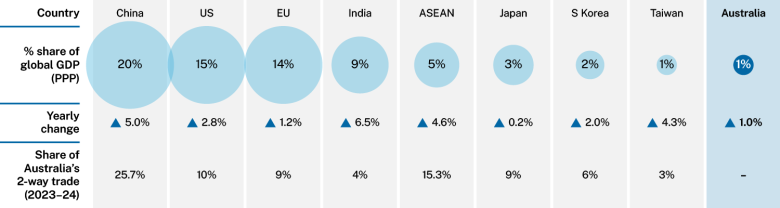
  • Australia’s trading partners had better-than-expected growth in 2025 but are now being stymied by the hostilities in the Middle East. China was resilient in 2025 despite rising barriers to its exports. In 2026, China is expected to have lower GDP growth with policy aiming to cut excess capacity and stimulate domestic demand. Over the outlook period, many of Australia’s key trading partners are expected to grow strongly, especially Vietnam and India.
REQ June 2026 chart - macroeconomic outlook

Iron ore

Iron ore prices were resilient in the June 2026 quarter, despite week global steel output. Prices are forecast to decline in the coming years due to rising supply from Africa, Brazil and Australia.

  • Australian iron ore export volumes rose by 6% year-on-year in the March quarter 2026. After 2 decades of rapid growth, output is expected to level off within the next 2 years, as new mines and expansions largely replace exhausted operations.
  • World steel production is expected to reach around 2 billion tonnes by 2031. Falling output in China is expected to be offset by higher production in India, Southeast Asia, and the Middle East.
  • Iron ore prices are expected to soften over the outlook period, as global supply rises and steel demand softens. Lower prices will reduce Australia’s iron ore export earnings from $117 billion in 2025–26 to $108 billion in 2026–27 and $77 billion (in real terms, base 2025–26) by 2030–31.
REQ June 2026 chart - iron ore

Metallurgical coal

Australia’s metallurgical coal export volumes are expected to increase by 1.1% per annum to 2030–31, supported by steady global steel demand.

  • Metallurgical coal prices are expected to be stable in real terms to 2031, with supply and demand broadly in balance.
  • Exports volumes are forecast to increase to 163 million tonnes (Mt) in 2028–29 before easing to 158 Mt in 2029–30 and 157 Mt 2030–31.
  • Export earnings are expected to fall from $38 billion in 2025–26 to $36 billion in 2028–29 (in real terms) before falling further to $34 billion in 2030–31.
REQ June 2026 chart - coal

Thermal coal

Thermal coal prices are expected to remain elevated in H2 2026. LNG shortages – due to ongoing trade disruptions in the Middle East – raise the demand for thermal coal.

  • Prices are expected to return to pre-conflict levels by early 2027. Over the remainder of the outlook period to 2031, real prices are expected to be broadly stable as demand and supply gradually decline.
  • Exports are forecast to fall gradually from 209Mt in 2025 to 197 Mt in 2031. Demand from key importers of Australian thermal coal is expected to moderate as they prioritise decarbonisation and domestic energy security.
  • Export earnings are forecast to fall from $30 billion in 2025–26 to $29 billion in 2026–27 and decline further to $23 billion (in real terms) in 2030‍–31.
REQ June 2026 chart - coal

Gas

Middle East trade disruptions have pushed LNG prices up sharply in the near term and raised price expectations over the outlook period.

  • Australia’s LNG export earnings are forecast to rise from $59 billion in 2025–26 to $65 billion in 2026–27 due to higher prices, before declining to $41 billion (in real terms) by 2030–31. The long-term earnings forecast profile has been revised down from the March 2025 REQ as loss of Qatari LNG supply potentially drives demand destruction.
  • New supply from the US and Qatar is forecast to lower LNG spot prices from US$15.70/MMBtu in 2026 to around US$8.50/MMBtu (in real terms) by 2031. The long-term outlook is for higher prices than forecast in the March 2025 REQ as growth in Qatari output is likely to be slower than planned due to infrastructure damage.
REQ June 2026 chart - gas

Oil

The conflict in the Middle East has resulted in high prices and extreme volatility. Australia’s short run export values are expected to remain elevated through 2026 and 2027. In outer years of the forecast, earnings are expected to normalise as volumes and prices fall.

  • Oil prices rose in 2026, as the US moved naval forces towards the Middle East. The start of military operations in late February saw prices jump to multi-year highs. Prices remain elevated and forecasts highly uncertain.
  • Oil prices are expected to remain elevated in the near term due to the impacts of trade disruptions from conflict in the Middle East. Oil prices are expected to remain elevated in the near term due to the impacts of trade disruptions from the conflict in the Middle East. A subsequent decline and stabilisation to around US$65 a barrel (in real terms) is expected to the end of the outlook.
  • World supply is forecast to be mostly steady from 2028, hitting 107 million barrels a day (mb/d) as long expected supplies from the Americas comes online.
  • Australian exports are forecast to fall from $10.4 billion in 2025–26 to $5 billion in 2030–31 (in real terms) as volumes and prices fall.
REQ June 2026 chart - oil

Uranium

Global uranium demand is surging due to strong demand for nuclear energy, resulting in rising prices. As a result, Australia’s uranium export earnings are expected to rise to $1.7 billion in real terms and level off.

  • Uranium prices are expected to rise from US$85 a pound in H2 2026 to average US$95 (in real terms) in 2031.
  • The rollout of new nuclear reactors is projected to increase uranium consumption from 91Kt in 2025 to 104 Kt in 2031, driven by increased demand for low-carbon-emissions energy.
  • Australian export values are projected to rise from $1.6 bn in 2025–26 to $1.8 bn (in real terms) in 2030–31.
REQ June 2026 chart - uranium

Gold

Australia’s gold export earnings have been revised down slightly across the outlook period. Export earnings are projected to grow by 1.4% a year, reaching $55 billion in 2030–31 (in real terms), driven by moderating prices and increased export volumes.

  • The gold price hit a new record of US$5,405 an ounce in late January 2026 but then eased as a result of rising energy prices and expectations of higher interest rates. The gold price is forecast to remain high in H2 2026 and 2027 before falling slowly over 2028. The price is projected to be around US$4,000 an ounce in 2031.
  • The extraordinary surge in gold prices in recent years is pushing up global mine supply, with a peak expected in 2027 ahead of supply easing due to anticipated mine closures and exhaustion of reserves. There will be a moderate supply surplus over the outlook period which will diminish from 2028 onwards.
  • From $68 billion in 2025–26, high prices and rising export volumes are forecast to push gold earnings to $73 billion in 2026–27 before dropping to around $55 billion by the end of the outlook period (in real terms).
REQ June 2026 chart - gold

Aluminium, alumina and bauxite (AAB)

Australia’s AAB export earnings are projected to be steady at $19 billion in real terms over the outlook period, with upside risk.

  • High demand for aluminium is forecast to keep the aluminium price high at US$3,425 a tonne in H2 2026. This price strength is due to the energy transition and tight supply, exacerbated by Middle East trade disruptions. The aluminum price is projected to average US$2,900 a tonne in real terms in the period from 2028 to 2031.
  • Disruptions to aluminium smelters in the Middle East has curbed the demand for alumina and caused the price of alumina to soften. After 2026, output cuts in China and Australia are set to tighten supply and support the alumina price. The Platts FOB alumina price is projected to be over US$360 a tonne in real terms over the outlook period.
  • Australia’s annual bauxite output is expected to be steady at above 100 Mt a year over the outlook period. An output cut at the Yarwun alumina refinery is set to lower Australia’s annual alumina output to 16 Mt over the outlook period. Australia’s primary aluminium output is likely to steady at 1.7 Mt per annum over the outlook period.
  • Australia’s AAB export earnings are projected to be steady at $19 billion in real terms over the outlook period, as elevated aluminium prices and export values offset sluggish alumina prices and export values.
REQ June 2026 chart - bauxite

Copper

Copper demand is expected to slow in H2 2026 amid geopolitical uncertainty and softer economic conditions. Market conditions are expected to strengthen from 2027. Robust demand and tight supply is expected to keep the prices elevated through 2028, before easing slightly by 2031.

  • LME copper prices surged 38% year-on-year Q1 2026, reaching an all-time high of US$14,500 a tonne in January. Prices have since eased but remain elevated, supported by mine disruptions and risks of sulphuric acid shortages. The latter are linked to the Middle East conflict, with about 20% of world refined copper produced using the acid in the solvent extraction and electrowinning (SX‑EW) operations.
  • Global copper demand is expected to slow in 2026 amid geopolitical uncertainty and softer economic conditions. It is then expected to strengthen from 2027, driven by the demand for clean energy technologies, data centres and broader electricity infrastructure. Meanwhile, supply is expected to show only gradual growth due to delays in new mines and expansions.
  • Australia’s export earnings are projected to increase from $14.6 billion in 2025–26 to $18.3 billion (in real terms) in 2030–31, driven by higher prices and increased refined copper and copper concentrate exports.
REQ June 2026 chart - copper

Nickel

Nickel prices have recovered noticeably in the first half of 2026, underpinned by recent supply shocks. While prices are forecast to ease from current elevated levels, a shift in the global market toward deficit by the end of the outlook should maintain prices above US$17,000 a tonne (real terms). An expected recovery in Australian production later in the outlook will see a rise in exports to $1.7 billion (in real terms) by 2030–31.

  • Sustained growth in global refined nickel supply is expected to contain prices at around US$17,000 a tonne (real terms) to 2031. However, emerging supply risks raise the possibility of a tighter market balance (and higher prices) earlier in the outlook period.
  • World nickel demand is projected to see steady growth over the outlook period, with EV batteries increasing in share of global end-use demand. Growth in global stainless-steel production is expected to ease from the high levels of recent years but will continue to underpin demand to 2031.
  • Low prices and closures in 2024 are expected to see Australia’s export earnings drop to $1.3 billion in 2025–26. However, an expected recovery in production later in the outlook will see a rise in exports to $1.7 billion (in real terms) by 2030–31.
REQ June 2026 chart - nickel

Zinc

Zinc prices have more than recovered the sharp decline experienced in the second half of March. At over US$3,500 a tonne, they are now near 4-year highs. The recent rebound reflects the impact of mine supply shortages and smelter problems. These include fires at the Kazzinc (Kazakhstan) and Cajamarquilla (Peru) smelters and the shutdown of Japan’s Toho smelter.

  • Zince prices surged in the June quarter, rising above US$3,500 a tonne in mid mid-May 2026. Prices are forecast to average US$3,270 a tonne in H2 2026, but ease to US$2,700 a tonne (in real terms) over the outlook period to 2031.
  • Supply is set to grow moderately, driven by China adding new smelting capacity. Ex-China output is also expected to rise but will be constrained by the supply of zinc concentrate. Demand growth will be soft due to ongoing weakness in China’s construction sector and modest Ex-China demand.
  • Australia’s zinc exports are estimated at $4.1 billion in 2025–26. They are forecast to decline to almost $3 billion (real terms) in 2030–31 as prices ease.
REQ June 2026 chart - zinc

Lithium

Lithium prices have rebounded sharply from mid‑2025, following notable supply shocks in China and Zimbabwe and robust demand throughout the supply chain. Prices for spodumene and lithium hydroxide are expected to stay elevated in the near term as inventories are rebuilt but should moderate from 2027. Australia is expected to see robust growth in mined and refined lithium production over the outlook period.

  • Australia’s lithium export earnings are projected to increase from $9.9 billion in 2025–26 to $12.5 billion in 2026–27 (in real terms). They are expected to moderate to $10 billion in 2030–31 as prices ease from current levels.
  • Australian mine output is expected to grow by about 8% annually to 2031, underpinned by mine expansions especially at our biggest mines.
  • Global lithium demand is projected to grow by over 11% a year to 2031, driven by continued strong trends in electric vehicle (EV) adoption and battery energy storage system (BESS) deployment.
  • Global supply is projected to grow by 10% annually, likely to leave the market oversupplied early in the outlook period before moving back into balance by 2030.
REQ June 2026 chart - lithium

Other critical minerals

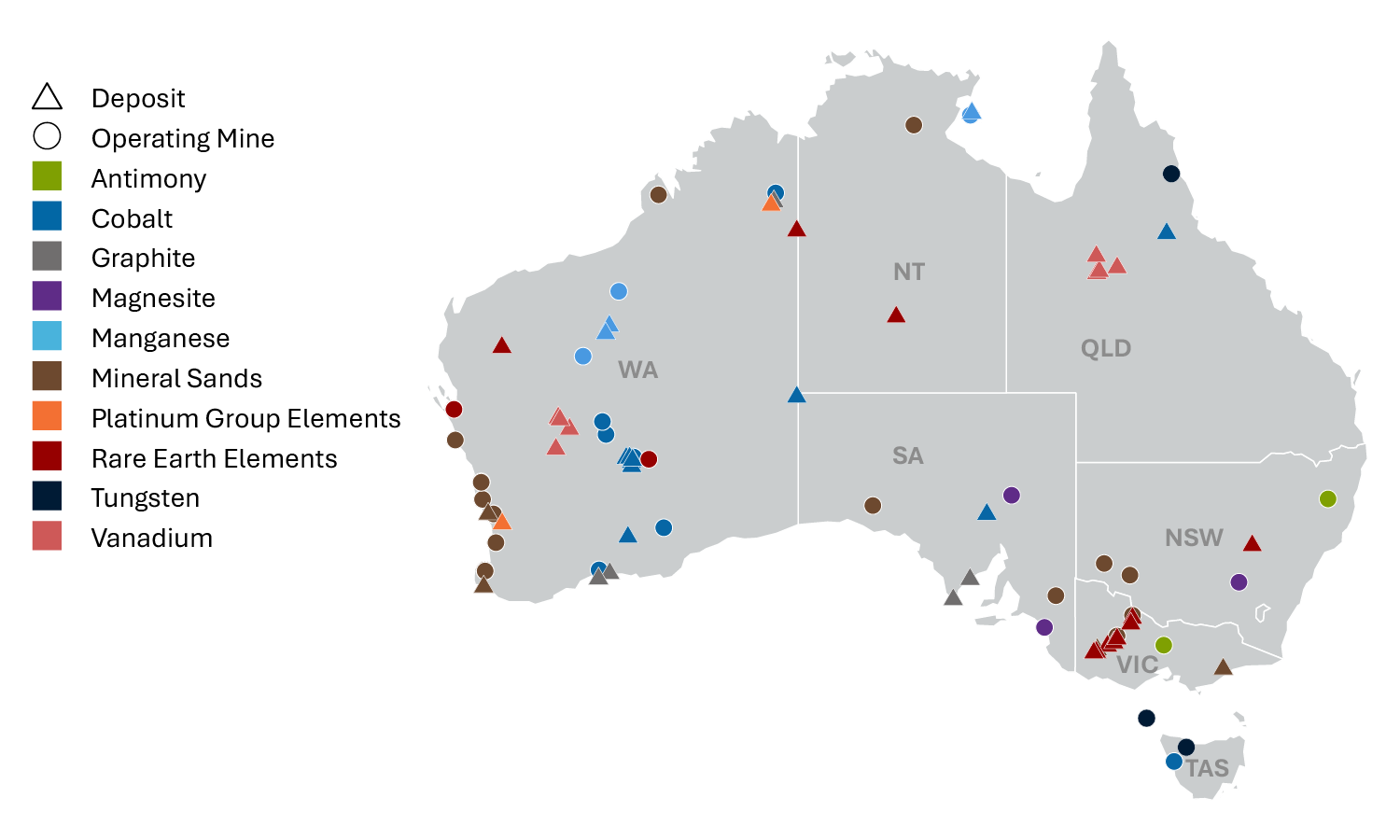
Australia’s export earnings from other critical minerals are expected to increase from $5.5 billion in 2025–26 to $7 billion in 2030–31 in real terms. This will see Australia’s total real exports earnings from critical minerals (including lithium and nickel) rise to $19 billion by the end of the outlook period.

  • Manganese, mineral sands and rare earths make up the majority of other critical minerals export earnings. Rare earth exports are expected to be more than triple in nominal terms, led by increased prices and intermediate and refined output.
  • Electrification of transport and power systems will underpin demand for critical minerals over the next 5 years, though emerging end-uses (such as data centres and robotics) will also add to demand. However, demand outcomes will vary across minerals depending on factors such as export controls, technology adoption, substitution and recycling.
  • Short-term prices of critical minerals are increasingly shaped by a range of geoeconomic factors, export controls and supply chain disruptions. Prices are expected to moderate over the medium term, as supply chains adjust.
REQ June 2026 chart - critical minerals