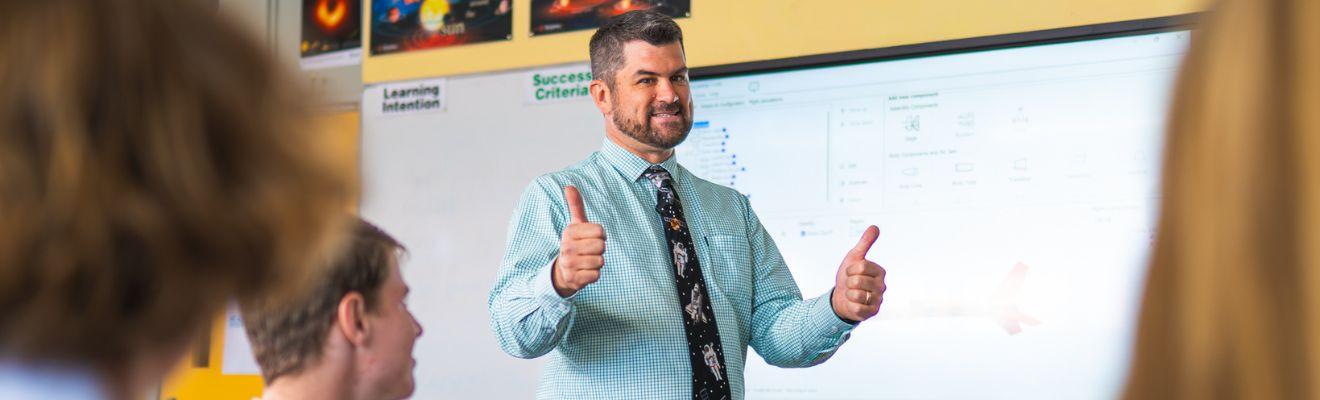
[An image appears of Matt Dodds walking and talking with students outside, and images move through to show hands attaching a toy rocket, and the students looking to the left, and text appears: Matt Dodds, 2025 Prime Minister's Prize for Excellence in Science Teaching in Secondary Schools]
Matt Dodds: I was extremely excited and proud to be nominated for the Prime Minister's Prizes for Science.
[Images move through to show views of Matt talking to the camera, views of Matt teaching students, and views of Matt and students outside with a rocket and then outside with a telescope]
I felt like it put a spotlight on all the different projects and work that I've been involved with over the last couple of years, and my whole career teaching science, the fact that I've done some pretty amazing things, and it's great to share those things with other teachers as well.
[Image changes to show students looking at a laptop in a science activity, and the image changes to show a student watching hands pour a clear liquid into a bottle with brown balls, and text appears: Paula Taylor, 2025 Prime Minister's Prize for Excellence in Science Teaching in Primary Schools]
Paula Taylor: The science teaching prizes are absolutely imperative.
[Images move through to show Paula smiling at students, a medium view and then a close view of Paula talking to the camera]
It recognises great teaching and great teaching of science, and that's really the catalyst to get students inspired so that we can fulfil that STEM pipeline.
[Image changes to show Matt talking to the camera]
Matt Dodds: The science teaching prizes are really important to recognise great science teaching.
[Image changes to show a close view of copper wire rolls bolted onto a prototype, and then the image changes to show a jar lid with a fan drawn on it spinning in the centre of the copper rolls]
No scientists exist alone.
[Image changes to show a female student talking while touching and pointing at the copper wire prototype]
They were taught once in a science classroom.
[Images move through to show Matt talking to the camera, the female student talking, and then Matt with students smiling at the camera]
It's really important to recognise that that pipeline from student to scientist starts with a great science teacher.
[Images move through to show Paula giving a presentation to students on Colonizing the Moon, Paula’s hand pointing at graphs and data on a screen, and then students in a science class listening]
Paula Taylor: If you're in a position to nominate someone, please do.
[Image changes to show a wide view of a Paula talking with colleagues while walking towards the camera]
Those teachers are transforming kids' lives.
[Image changes to show a medium view of a Paula talking with colleagues while walking towards the camera]
They're doing great work.
[Image changes to show Paula using a laptop while in discussion with colleagues taking notes around a table, and then the image changes to show Paula talking to the camera]
It doesn't take much effort to really recognise those unsung heroes.
[Images move through to show Paula smiling at the camera, Matt talking to the camera, and then Matt smiling at the camera]
Matt Dodds: Nominate now for the Prime Minister's Prizes for Science.
[Music plays as image changes to show a Prime Minister’s Prize Medallion on the right and the Australian Government Coat of Arms above text on the left: The Prime Minister’s Prizes for Science 2026. Nominate an inspiring science teacher today! industry.gov.au/PMPrizes, #PMPrizes]